Monday, 27 February 2017

Body of Work, Assignment 5. Draft 3.

For this draft I have made a another edit of the images and re-sequenced them.  I have also given some more thoughts to the wording to accompany the work and the different versions of this can be found here.

I also need to work on an introduction and evaluation for the project.

The images can be seen large by clicking on a thumbnail.

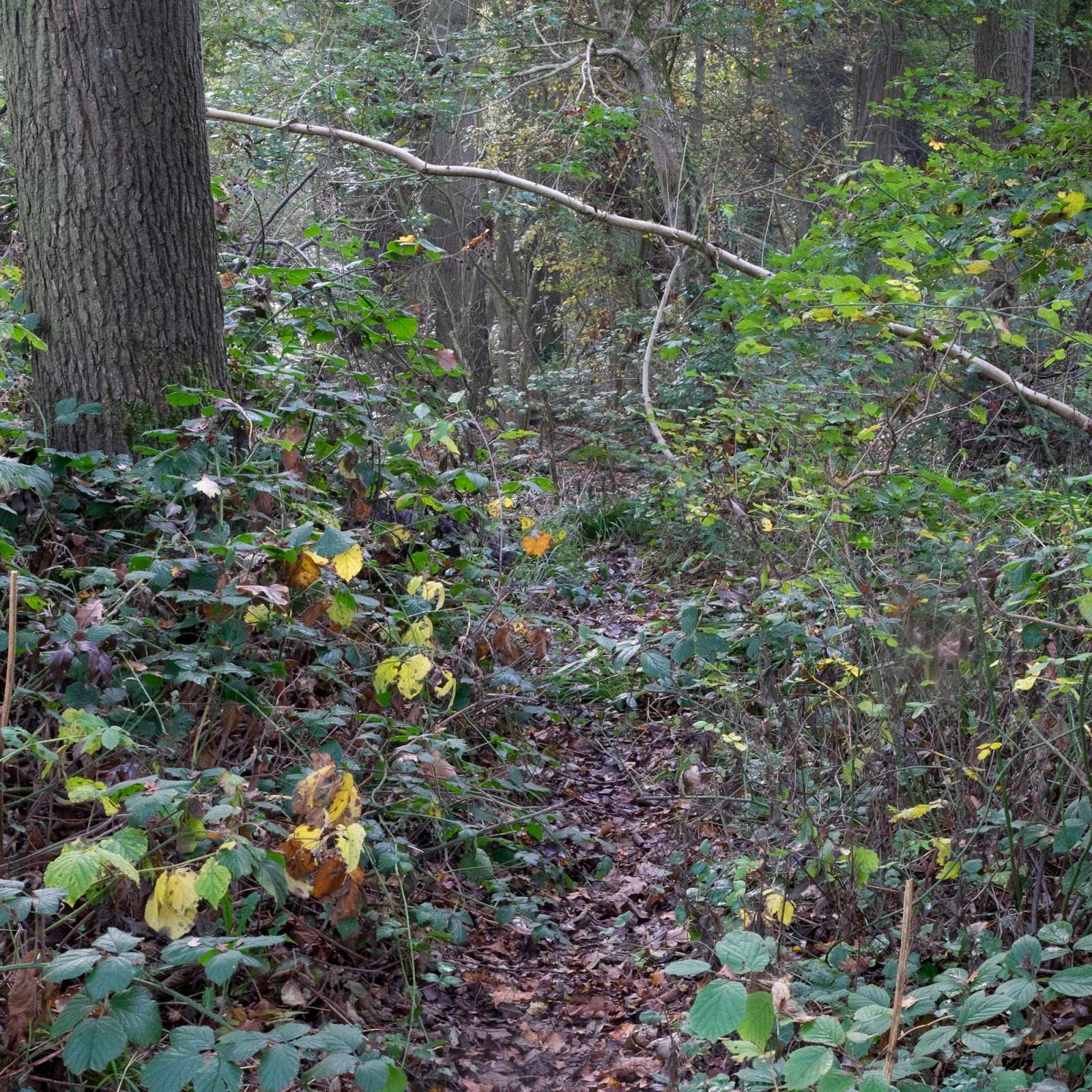
Paths

As I walk into the wood the path is broad and well-defined, boundaries are clear.  Many have passed this way. Beyond, the wood is wild and tangled.  Deeper in, choices have to be made, paths become narrower.  Fewer have now travelled the route.  Increasingly the way becomes less definite, ephemeral, a trace of a path. Eventually, perhaps only a bent blade of grass or scuffed leaves indicate that something has been here.  Finally, at the furthest extremity there is nothing. Just the wood.

1
2
3
4
5
6
7
8
9
10
11
12
13
14
15
16

Experimenting With Text to Accompany Assignment 5

I am still working on getting the best form of words to accompany my images for BOW Assignment 5 and have experimented with different ideas.

The first two examples are versions of earlier attempts, whilst the final example is written following reflection on feedback from my peer group hangout and a discussion with my tutor.  I wanted the text to be concise and yet get over my thoughts and feelings.  I didn't want to be too directive, yet wanted many of my earlier ideas and suggestions from other people to be implicit.

Walking in Woods

Walking allows me to slow down and fully experience and appreciate the landscape through which I travel.  Footpaths disappearing into the distance are seductive.  Woods can be places of mystery and paths often wind and twist, seeming to have no purpose other than to be followed, occasionally, it seems, through holes in the vegetation.  Decisions have to be made at junctions when the horizon is limited.  Paths are evidence of footsteps, human or animal, and perhaps hold memories.  Larger, wide, well-trodden paths may hold countless memories, whereas more indefinite ephemeral paths may hold only traces of memory of few passings.  How faint can these be and still be paths; how many memories?

Walking in Woods

Walking allows me to slow down and fully experience and appreciate the landscape through which I travel.  When walking in woodland, it is easy to lose and find oneself again, to reflect, meditate and to reconnect with the world.  Footpaths disappearing into the distance are seductive, perhaps holding memories of many passings over the years.  Woods can be places of mystery and paths often wind and twist, seeming to have no purpose except to be followed.  The horizon is limited and paths disappear round corners or through a hole in the vegetation, leaving the imagination to speculate on where they might lead or who or what might be there.  At other times paths are indefinite and ephemeral, so faint as to be nearly not paths.  Some are not as they seem and when followed lead to where no human could go.

Paths

As I walk into the wood the path is broad and well-defined, boundaries are clear.  Many have passed this way.  Beyond, the wood is wild and tangled.  Deeper in, choices have to be made, paths become narrower.  Fewer have now travelled the route.  Increasingly the way becomes less definite, ephemeral, a trace of a path.  Eventually, perhaps only a bent blade of grass or scuffed leaves indicate that something has been here.  Finally, at the furthest extremity there is nothing; just the wood.

On balance my preference at the moment is for version 3.  As well as these few short words I also now need to work on a further edit of the images and the introduction and evaluation for my work.

Tuesday, 7 February 2017

Beginning Sustaining Your Practice


Having reached the point where I am working on Assignment 5 in both Body of Work and Contextual Studies, I have registered with OCA for the Sustaining Your Practice module - the final one!!  I shall be recording my thoughts and progress during this module on a separate blog and the link for this is here.

Paradise: Thomas Struth

Another piece of work colleagues suggested I looked at was Paradise by Thomas Struth.  Struth was born in 1954 and is a German photographer best known for his Museum Photographs, family portraits and 1970s monochrome images taken in Dusseldorf and New York.  He divides his time between Berlin and New York.  Although not primarily a landscape photographer, Struth began searching for jungle settings throughout the world.  His first eight large-format Pictures from Paradise were made in 1998 in the Daintree Forest in Australia.  Struth first began thinking of forest images in 1996 and even planned an installation with several images surrounding the viewer.  After Daintree he made more work in Yunnan province in China, on the island of Yakushima in Japan, and in the forests of Bavaria, Germany, in 1999.  New Pictures from Paradise became the title for an exhibition of the first 19 images at the Marian Goodman Gallery, New York in 1999.  He was interested in the kinds of observation, contemplation or experience that the images could generate rather than being botanical images or a cry for a lost past.  He felt that it was a melancholy reflection at the turn of the millenium.  The work continued in other parts of the world and by 2010 comprised 36 works, all on a large scale.  While a small number of the images adhere to classic picturesque style many position the viewer before a screen of greenery that includes a great deal of detail without any traditional compositional style.  The viewer sees a forest or jungle but there is no story to be told; they are more to do with reflection, perhaps mirroring his interest in reflective meditational Tai Chi.

Public Delivery Website suggests that the title gives the images a special meaning as pictures of nature before the fall of man, referencing and questioning representations of paradise throughout history and cultures.

These images are certainly not minimalist.  They are full of detail.  I image that when seen full size they would be overwhelming and the viewer could spend a great deal of time on each poring of this vast amount of detail.  They are nearly monochromatic and could, perhaps be used as a meditation device in the same way as a Hindu or Buddhist manadala.  Struth's work is similar to mine in that he used it as a means to transport viewers into a realm of quiet self-contemplation; exactly words that I have used about my BOW and what I feel when I walk through woods.

References

Public Delivery (2017) Thomas Struth's Jungle Pictures May Make You Feel Helpless [online] Public Delivery. Available from: http://publicdelivery.org/thomas-struth-paradise/ [Accessed 07/02/17]

Tate (2017) Thomas Struth [online] Tate. Available from:
 http://www.tate.org.uk/art/artists/thomas-struth-2339 [Accessed 07/02/17]

Struth, T. (2010) New Pictures From Paradise [online] Thomas Struth. Available from:
http://www.thomasstruth32.com/smallsize/photographs/new_pictures_from_paradise/index.html#

John Gossage: The Pond

When I shared my BOW with my peer led hangout group last week, one of my colleagues suggested that I look at John Gossage's work, The Pond.


Wikipedia tells us that John Gossage is an American photographer who is renowned for his artists books and uses his photographs to explore parts of the urban environment that are under-recognised such as abandoned tracts of land, debris, refuse and graffiti - edgelands to use current terminology.  Aperture website tells us that The Pond was groundbreaking when it was first published in 1985.  Today its subject matter would be commonplace.  It comprises images of a pond situated in a scruffy piece of edgelands woodland, a foil to Thoreau's Walden (Aperture 2017).  Rather than grand landscape in the tradition of Ansel Adams, we are told, instead, they reveal reality on the border between nature and humankind - (nature and culture?).  Robert Adams describes the work as believable because it reveals the darker side of man while it also demonstrates Gossage's passion for what remains of nature (Adams, 2013).  Adam's describes the book as a work of irony which focuses on the ugliness of man's despoliation of the environment, but  Americans at the time do not yet appreciate what they have done (Adams, 2013).  The same criticism could be levelled at many in this country.
Gossage's work is very different to my own with a different purpose but it does portray a walk around a piece of woodland (containing a pond).  I have, at times, in my current BOW turned my camera on man's carelessness on my journeys through woodland, but that is not currently my theme.  Gossage's work is also in monochrome whereas mine is in colour.  The book is unusual for its time in that it contains no image on the cover, merely the title.  Despite the differences in work there are images of paths through his wood that are similar to ones I have taken and I think in particular of one very narrow path leading into the distance which is also similar to one of Richard Long's.  A couple of paths disappearing into vegetation would also work in my current work.  The book is arranged so that there is an image on the right hand page with a blank page on the left.  There are no captions.


Adams, R. (2013) Robert Adams on John Gossage's 'The Pond' [online] ASX. Available from: http://www.americansuburbx.com/2013/02/john-gossage-john-gossages-the-pond-1986.html [Accessed 07/02/17]
Aperture (2017) John Gossage - The Pond [online] Aperture. Available from: http://aperture.org/shop/john-gossage-the-pond-book/ [Accessed 07/02/17]
Wikipedia (2016) John Gossage [online] Wikipedia. Available from: https://en.wikipedia.org/wiki/John_Gossage [Accessed 07.02.17]

Monday, 6 February 2017

Footpaths and Memory

Intrigued by the idea of the landscape and memories I have experimented with the following images. I was prompted to blog them when one of my peer to peer hangout group suggested that he saw my footpath images " as traces, evidence of footsteps, memories of human purpose; perhaps just memories."  He felt that the wide open glades make a sense of human presence manifest, we know that many thousands of people have walked here before.  However, the paths become more and more faint until "perhaps the brush of grass is sent one way and not the other and this is a palimpsest; a trace of a path, a memory."
These comments reminded me of the images below that I had made before the hangout when I had been thinking along the lines of landscape and memory.  I have often reflected that we have memories of our walks and wanted to record this idea in single images.  To do this I took one image and then walked on, stopped and took another image looking along the path and repeated this up to five times.  Then, in photoshop I layered these images over one another in much the same way as memories are layers of our past experiences.  In the first of the to images below the constituent shots are straight photographs; in the second pair I moved the camera slightly on exposure to give a more abstract feel.  Perhaps these images can be thought of as photographic palimpsests.  At the moment these are just experiments as I am not sure that they fit with the main series of images in my work.  It is tempting to continue trying new ideas, but at this stage in my BOW I feel that I need to consolidate rather than keep making new images.  Still I shall keep this idea in mind for future work.  Perhaps I could continue to work on the idea during SYP with the idea of an extra series of images for a final exhibition or book.


The Road Not Taken; Robert Frost


During our Peer to Peer Hangout last week when my work was being shared, one member suggested I look at Robert Frost's Poem The Road Not Taken which I include below.

The Road Not Taken


Two roads diverged in a yellow wood,
And sorry I could not travel both
And be one traveler, long I stood
And looked down one as far as I could
To where it bent in the undergrowth;

Then took the other, as just as fair,
And having perhaps the better claim,
Because it was grassy and wanted wear;
Though as for that the passing there
Had worn them really about the same,

And both that morning equally lay
In leaves no step had trodden black.
Oh, I kept the first for another day!
Yet knowing how way leads on to way,
I doubted if I should ever come back.

I shall be telling this with a sigh
Somewhere ages and ages hence:
Two roads diverged in a wood, and I—
I took the one less traveled by,
And that has made all the difference.

This poem really resonated with me, reminding me of ideas that I had already included in my introductory text. On researching a commentary about the poem I discovered that it can be read on two levels. It can be read as a commentary on life and decision making, but, in fact, it was written as a joke for Frost's friend, poet, walker and naturalist Edward Thomas. When they went walking together Frost found Thomas chronically indecisive about which path they should choose and in retrospect often regretted the choice they had made.  Robert MacFarlane describes Edward Thomas as a 'foot philosopher' MacFarlane, 2016, p238).  In the Old Ways MacFarlane describes Thomas as a confident, solitary walker and that his poems are 'thronged with ghosts, dark doubles and deep forests in whch paths peter out....' (MacFarlane, 2013, p25).  This fits well with the idea of my images teasing the viewer: paths appear to go through a hole, but the paper is flat, 2D; how faint can a path be and still be a path, when is a path not a path because it is an animal track.  It also fits with the idea of paths being a metaphor for life or for memory.

MacFarlane, R. (2016) Landmarks. London: Penguin
MacFarlane, R. (2013) The Old Ways. London: Penguin
Robinson, K. (2016)Robert Frost: "The Road Not Taken" [online] Available from: https://www.poetryfoundation.org/resources/learning/core-poems/detail/44272#guide [Accessed 06.02.17]