Showing posts with label Body of Work. Show all posts

Monday, 8 May 2017

Revised Evaluation of my Body of Work.

In his feedback to my Body of Work, my tutor felt that my evaluation was bold and honest, although a little long.  In light of this comment I have edited it somewhat and the revised version is included below.


Evaluation of Body of Work
I began my Level 3 work having scored consistently in the high 50s at summative assessment for my Level 1 and Level 2 modules with a desire to achieve marks at least in the 60s.  It soon became apparent to me that reading and research had been lacking in earlier work.  An important landmark was attending the Barnsley Residential Study Weekend in June 2015.  It was at Barnsley that I realised that the work I was producing and the lack of academic research backing it up was not up to a ‘good’ creative arts photography degree.  Tutors and fellow students felt that the work that I had taken was too scientific and too much within my comfort zone and certainly not risk-taking enough.  My blog link to the visit can be found here.  A huge benefit of this weekend was meeting fellow students and seeing their work.  I was fortunate that, following the visit, I was able to join some of them in a fortnightly Peer Led Google Hangout to discuss our work.  This has been invaluable from the point of view of receiving critiques of my own work, sometimes harsh and truthful, but always constructive and also helping to critique the work of others.  Since the Barnsley weekend I have attended study visits at The Hepworth in Wakefield, Sheffield and particularly the weekend residential for the Brighton Bienniel.

The work I submitted for Assignment 1 was weak.  I had already had thorough feedback from the Barnsley Weekend, yet still I ploughed on with that work.  In retrospect I was no doubt feeling some time pressure with a deadline looming, but I should have given myself the time to go back, do some thorough research, think about what I wanted to say and start again.  However, I felt that I was floundering after the weekend and was still absorbing all of the criticisms and ways forward and felt that I would submit the work, revised a little in the light of the weekend, and see what my tutor had to say.  He felt that ‘floundering’ was an uncomfortable position to be in, but it could be turned to my advantage, although I should be careful not to slip back into safe and habitual patterns of thinking.  When working towards Assignment 2 I hadn’t really taken this last point in.  My tutor thought that some of the images did work, there was plenty of investigation going on in my blog and suggested ways to progress.  He guided me away from the images I had taken in woodland, inspired by Eliot Porter, as this would take me too much down a scientific, non-creative line.  When considering where my Body of Work has finished, I feel it wasn’t the wood that was the problem, just my approach to it.  Having reflected on this first tutor report I opted to concentrate on two of my ideas from Assignment 1: flowers within an industrial landscape and The Water Rail Way/ River Witham, deciding to focus on the second of these options.

On rereading my reflections on Assignment 1 and the tutor feedback I feel that I could have made more of the industrial landscape aspect, although there was a danger of yet again straying into the scientific and picturesque.  The River Witham provided a link with my childhood, the river and the old railway line and there was scope for investigating landscape and memory.  Regrettably, I defaulted to a picturesque style when documenting the journey of the river from source to sea, compounded by the fact that I quoted Tennyson’s poem The Brook thereby unintentionally allying myself uncritically within the Victorian World view.  I had, by this time, begun to play catch-up with my reading and research and had looked at the work of Alec Soth, Jem Southam and Andreas Muellerpohle yet didn’t apply what I had learned to my work.  My reading and research still continued to be divorced from my practice.

Another mistake I made in Assignment 2 was to provide too much information in my accompanying text, one of my Hangout Group remarking that I had provided so much information that he no longer felt he needed to see the pictures.  I was still straying into scientific/geographical descriptions.  It was felt by the group that my thinking was unclear and the confusion was evident in the images although, I did then further edit before submitting Assignment  2.  The group unsurprisingly agreed with my tutor’s comments and, if anything, were even harsher in their criticism, whilst remaining very supportive. However, my tutor felt that some of the images did work, particularly the use of soft grey light which added to the sensitive and tentative feeling, one in particular being taken from a high viewpoint, which, with the soft light, helped separate it from the postcard views that were so ubiquitous.  He felt that there was the start of a personal voice that was less evident in some of the more literal sections of the series.  The use of soft, muted lighting was something I learned and have put to good use in later work.

At the start of Assignment 3 I still clung to the idea of the River Witham , its valley, and the large number of Abbeys.  In order to investigate these I decided to walk from Lincoln along the Viking Way Long Distance Footpath to my childhood home of Woodhall Spa visiting and documenting these abbeys and the walk.  I think that whist working on this assignment, two things emerged which finally began to change me from a landscape and a scientific wildlife photographer into a creative arts photographer.  Firstly while sharing the early work to the Hangout Group the comment was made, “Why Walk?”  It was only on reflection that I realised that that was what I did and had done all of my life; I was a walker.  This re-directed me and I spent much time researching photographers, artists and writers who had used walking as an inspiration for their work.  The second was when my tutor wondered why I was still including images of the abbeys in the work.  The focus now changed, for the remainder of my body of work it has been about walking.

I was encouraged when I read the opening statement on my tutor’s report: “A sense of focus is beginning to emerge as you reach deeper for your personal voice”.    I had sent some sample prints with the work which were received positively.

As my walk for Assignment 3 had passed through some of the ancient Lincolnshire Limewoods, I began to centre my explorations on woodland, concentrating on photographing the paths along which I walked.  I also made the decision to crop the images to square, initially to maintain uniformity of format, but later I realised it helped to distance my work from the picturesque.  I had now begun to eliminate the horizon. Colleagues and tutors at Brighton and in the Hangout Group felt that this reduces the ability to resolve the images in the frame making the viewer enter into a dialogue with them.   As I worked towards Assignment 4 comments about the work were becoming more positive.  Several still felt that the text was too long and Clive White at Brighton strongly recommended removing the more romantic references. 

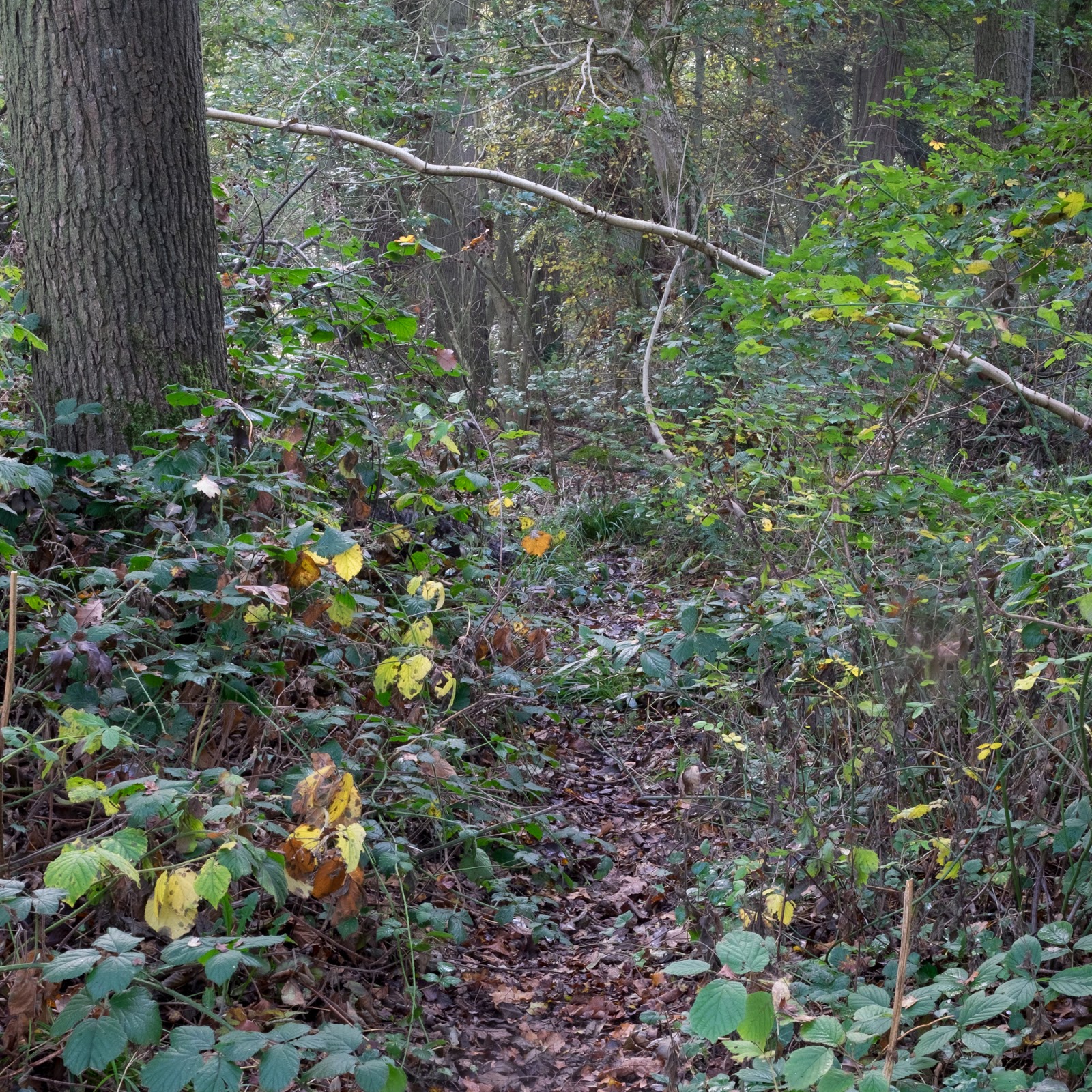
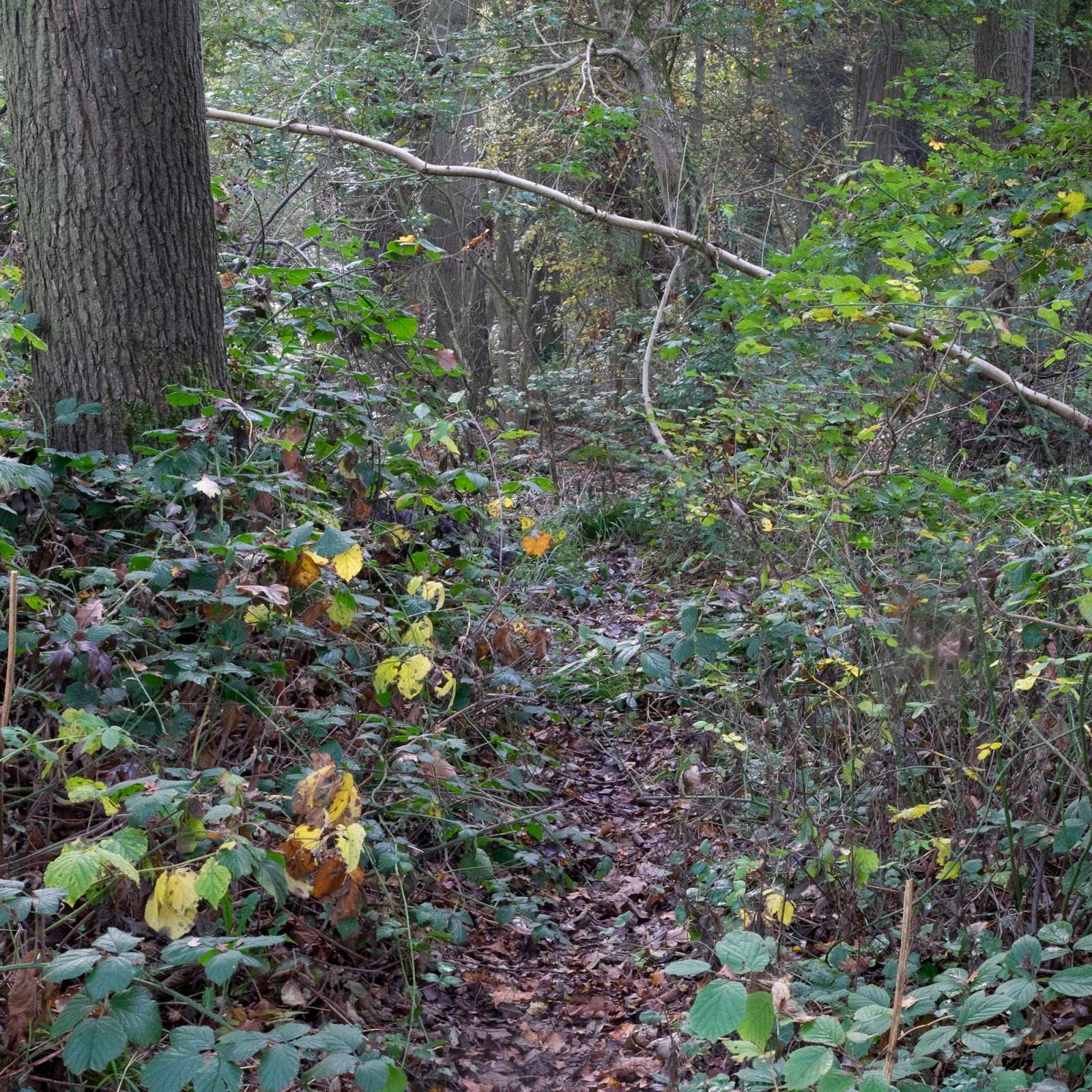
Again the tutor feedback from Assignment 4 was generally positive; I was sharing the work widely and absorbing everything I could.  Rob felt that the images looked lovely on screen, although some of the prints lacked clarity, perhaps because of the textured, heavyweight matte paper I had used.  I have since experimented with printing on different papers and sent them for his observations.  We both feel that those printed on Oyster paper were preferable.  He did still feel that the text still contained too many ideas and I need to keep it focused.  This is perhaps where the challenge lies as I work towards assessment.  Another suggestion made in the feedback was to go back to the woods to the extremes of the pathways I had photographed and look there for the starting point for the next exploration.  I had already been investigating this idea and had discovered paths that are not paths; at least not human ones.  When we think of footpaths the tendency is to think of human paths, but the faintest most ephemeral tracks, perhaps just a bent blade of grass or scuffed leaves are most likely not human.  And when these peter out all that is left is wild wood.

As my work has progressed I feel that I am beginning to discover my personal voice.  From my reading and discussions and, especially an OCA forum discussion lead by Clive White and Peter Haveland, I feel that a personal voice is difficult to grasp.  Peter says that it is not about style or technique.  I have latterly put aside my DSLR bodies, macro and long telephoto lenses, filters, differential focussing and used my small mirrorless compact for much of my work.  The only technique I have tended to stick to is using a tripod to make sure that everything is sharp and in focus, although, in some situations this is not the most important criterion.  Peter says that it is to do with making work that is recognisably yours and is about something you want to say.  Although my personal voice may be beginning to develop, I feel that it may still be like a stuttering candle flame.  I keep in mind, though, that Body of Work is not the end of my studies and my personal voice will continue to develop during Sustaining Your Practice and beyond.

During my progress through BOW I have had highs and lows.  Lows were when I thought I was beginning to get things right but hangouts and tutors thought otherwise.  I have found that these times are when most learning takes place.  I have been tempted at times to give up, but after reflection, I feel that I have always moved forward and improvement has taken place.  My tutor has always been supportive but challenging. I have valued this and it has helped me to progress.  I have also to thank one of my peer group, in particular, for supporting me through one particular low patch.  We exchanged many emails until he had counselled me through this phase.  I have thoroughly enjoyed my increasing levels of reading and research and this has brought me into contact with photographers, artists, writers, students and tutors, all of whom have influenced and inspired me.  There have been high points too, in particular when I first shared work to the Hangout Group and received positive comments about my work.  There was also the occasion when I received a comment of “excellent” from my tutor on one section of his report and the times when he has commented that he was beginning to see a personal voice emerging or he felt that I had done enough research and needed to absorb it and finally the excitement in his voice when he looked at a particular image. 

Looking forward, I currently see my work as a gallery exhibition, perhaps with an accompanying audiovisual component.  There are several venues locally that I am in the process of exploring for this to happen.  Helped by the fact that there is a highly thought of fine art department at our local university department, there is a thriving art and gallery scene in this area.  I have already begun a process of networking, talking to artists, a post graduate art group, curators and photographers and I hope to become part of an ArtSpeak ArtWork initiative led by Meridian Arts.  Although I will be submitting my portfolio for the final Body of Work assessment as a set of prints, I see scope for the work developing further during the Sustaining Your Practice module.


Tuesday, 18 April 2017

Revised Introduction to My BOW

Having reflected on the feedback from my tutor on Assignment 5 I have revised my introductory text in line with his comments:-


Shul
The Tibetan word for a track is shul which means "a mark that remains after that which made it has passed by - a footprint, for example.  A path is a shul because it is the impression in the ground left by the regular tread of feet, which has kept it clear of obstructions and maintained it for the use of others."  (Solnit, 2005, P.51).  My work focuses on woodland paths, shuls, and walking them allows me to slow down, to fully experience and appreciate the landscape through which I travel.

Like artists and photographer Hamish Fulton, Richard Long and Paul Gaffney I have long found walking to be a meditative experience (Turner Contemporary website, 2012;  Global Archive Photography, 2015).  Roger Deakin writes ‘To enter a wood is to pass into a different world in which we ourselves are transformed.  It is where you travel to find yourself, often, paradoxically, by getting lost.’ (Deakin, 2007, P. X).  

Following a woodland path is not straightforward.  The horizon is limited.  Woods muffle external sounds leaving only birdsong, the rustling of leaves or the creaking of trees in the wind.  Choices have to be made.  The path may be broad and well-defined; boundaries may be clear with wild and tangled undergrowth beyond.  Other paths are less definite, ephemeral, a trace of a path.  Perhaps there will only be a bent blade of grass or scuffed leaves that indicate that something has passed this way.  Is the decision made to remain on the wider track, safer, more secure where many have travelled before; or is it to follow the less sure route and, if so, what is to be found at its furthest extremity?  Nothing - just the wood?  Or is there a way forward by making one’s own path and forging a new route?

Bibliography
Bowditch, T and Rochowski, N. (2016) Paul Gaffney Global Archive Photography Available from: http://globalarchivephotography.com/project/paul-gaffney/  [Accessed 23.2.16]

Fulton, H. (2017) Hamish Fulton [online] Available from:
http://www.hamish-fulton.com/ [Accessed 18.4.17]

Gaffney, P.(2017) Paul Gaffney [online] Available from:  http://www.paulgaffneyphotography.com/ [Accessed 18.4.17]

Long, R.  (2017) Richard Long [online] Available from:
http://www.richardlong.org/ [Accessed 18.4.17]

Rohrauer. C (2014) Claudia Rohrauer [online] Available from: http://www.claudiarohrauer.info/?/work/photo-trekking/ [Accessed 18.4.17]

Solnit, R. (2006) A Field Guide to Getting Lost, Edinburgh, Canongate Books 


Turner Contemporary (2012) Hamish Fulton: Walk  [online] Available from: https://www.turnercontemporary.org/media/documents/Hamish-Fulton-background-resource.pdf [Accessed 18.04.17

Saturday, 18 March 2017

Body of Work, Assignment 5. Final Submission.

Having discussed this body of work with my tutor I agree that the work sorts itself into two series: wide paths with holes through the vegetation and narrower, more indefinite paths.  Having given this much thought I have decided to separate out the wider paths and focus on the more indefinite, with a view to using the others at a later date as I anticipate the work developing through the course of SYP. 

I have also produced these images as a video with some of the introductory text.  Please click THIS LINK

So the final images are:-


1
2

3

4
5
6

7

8

9

10

11

12

13

14

15

Tuesday, 7 March 2017

Body of Work, Assignment 5. Draft 4

After working on Draft 3 for assignment 5 I shared my work yet again with my Hangout colleagues. The overall opinion was that, although the whole was cohesive and the text and images went well together, there was a linearity to both.  In both the images and text I had led the viewer on a pathway through a wood until it came to an end and therefore allowed a safe way back.  It was felt that this was too 'safe' and removed some of the enigma and intrigue that the images had.  It was also felt that the final image didn't fit the series as the patch of light was too alluring.  I had wondered about this myself.  I have since been out to make some new work and have selected a new final image from those.  I have rewritten the text and included a new introductory paragraph in line with suggestions in the course notes.  I have also reordered the images slightly.

I include my fourth draft of this assignment below.


Woodland Paths

This work focuses on woodland paths.  My formative years were spent roaming the woods close to my home, developing a love for nature that was to last a lifetime.  Walking allows me to slow down, to fully experience and appreciate the landscape through which I travel.  Like artists and photographer Hamish Fulton, Richard Long and Paul Gaffney I have long found walking to be a meditative experience.  Roger Deakin writes ‘To enter a wood is to pass into a different world in which we ourselves are transformed.  It is where you travel to find yourself, often, paradoxically, by getting lost.’ (Deakin, 2007, P. X).   The Tibetan word for a track is shul which means "a mark that remains after that which made it has passed by - a footprint, for example.  A path is a shul because it is the impression in the ground left by the regular tread of feet, which has kept it clear of obstructions and maintained it for the use of others."  (Solnit, 2005, P.51).

Following a woodland path is not straightforward.  The horizon is limited.  Woods muffle external sounds leaving only birdsong, the rustling of leaves or the creaking of trees in the wind.  Choices have to be made.  The path may be broad and well-defined; boundaries may be clear with wild and tangled undergrowth beyond .  Other paths are less definite, ephemeral, a trace of a path.  Perhaps there will only be a bent blade of grass or scuffed leaves that indicate that something has passed this way.  Is the decision made to remain on the wider track, safer, more secure where many have travelled before; or is it to follow the less sure route and, if so, what is to be found at its furthest extremity?  Nothing - just the wood?  Or is there a way forward by making one’s own path and forging a new route?

Bibliography
Fulton, H. http://www.hamish-fulton.com/
Gaffney, P. http://www.paulgaffneyphotography.com/
Long, R.  http://www.richardlong.org/
Rohrauer. C  http://www.claudiarohrauer.info/?/work/photo-trekking/
Solnit, R. (2014) Wanderlust, A History of Walking, London, Granta 


1
2
3
4
5
6
7
8
9
10
11
12
13
14
15
16

Monday, 27 February 2017

Body of Work, Assignment 5. Draft 3.

For this draft I have made a another edit of the images and re-sequenced them.  I have also given some more thoughts to the wording to accompany the work and the different versions of this can be found here.

I also need to work on an introduction and evaluation for the project.

The images can be seen large by clicking on a thumbnail.

Paths

As I walk into the wood the path is broad and well-defined, boundaries are clear.  Many have passed this way. Beyond, the wood is wild and tangled.  Deeper in, choices have to be made, paths become narrower.  Fewer have now travelled the route.  Increasingly the way becomes less definite, ephemeral, a trace of a path. Eventually, perhaps only a bent blade of grass or scuffed leaves indicate that something has been here.  Finally, at the furthest extremity there is nothing. Just the wood.

1
2
3
4
5
6
7
8
9
10
11
12
13
14
15
16

Experimenting With Text to Accompany Assignment 5

I am still working on getting the best form of words to accompany my images for BOW Assignment 5 and have experimented with different ideas.

The first two examples are versions of earlier attempts, whilst the final example is written following reflection on feedback from my peer group hangout and a discussion with my tutor.  I wanted the text to be concise and yet get over my thoughts and feelings.  I didn't want to be too directive, yet wanted many of my earlier ideas and suggestions from other people to be implicit.

Walking in Woods

Walking allows me to slow down and fully experience and appreciate the landscape through which I travel.  Footpaths disappearing into the distance are seductive.  Woods can be places of mystery and paths often wind and twist, seeming to have no purpose other than to be followed, occasionally, it seems, through holes in the vegetation.  Decisions have to be made at junctions when the horizon is limited.  Paths are evidence of footsteps, human or animal, and perhaps hold memories.  Larger, wide, well-trodden paths may hold countless memories, whereas more indefinite ephemeral paths may hold only traces of memory of few passings.  How faint can these be and still be paths; how many memories?

Walking in Woods

Walking allows me to slow down and fully experience and appreciate the landscape through which I travel.  When walking in woodland, it is easy to lose and find oneself again, to reflect, meditate and to reconnect with the world.  Footpaths disappearing into the distance are seductive, perhaps holding memories of many passings over the years.  Woods can be places of mystery and paths often wind and twist, seeming to have no purpose except to be followed.  The horizon is limited and paths disappear round corners or through a hole in the vegetation, leaving the imagination to speculate on where they might lead or who or what might be there.  At other times paths are indefinite and ephemeral, so faint as to be nearly not paths.  Some are not as they seem and when followed lead to where no human could go.

Paths

As I walk into the wood the path is broad and well-defined, boundaries are clear.  Many have passed this way.  Beyond, the wood is wild and tangled.  Deeper in, choices have to be made, paths become narrower.  Fewer have now travelled the route.  Increasingly the way becomes less definite, ephemeral, a trace of a path.  Eventually, perhaps only a bent blade of grass or scuffed leaves indicate that something has been here.  Finally, at the furthest extremity there is nothing; just the wood.

On balance my preference at the moment is for version 3.  As well as these few short words I also now need to work on a further edit of the images and the introduction and evaluation for my work.

Tuesday, 7 February 2017

John Gossage: The Pond

When I shared my BOW with my peer led hangout group last week, one of my colleagues suggested that I look at John Gossage's work, The Pond.


Wikipedia tells us that John Gossage is an American photographer who is renowned for his artists books and uses his photographs to explore parts of the urban environment that are under-recognised such as abandoned tracts of land, debris, refuse and graffiti - edgelands to use current terminology.  Aperture website tells us that The Pond was groundbreaking when it was first published in 1985.  Today its subject matter would be commonplace.  It comprises images of a pond situated in a scruffy piece of edgelands woodland, a foil to Thoreau's Walden (Aperture 2017).  Rather than grand landscape in the tradition of Ansel Adams, we are told, instead, they reveal reality on the border between nature and humankind - (nature and culture?).  Robert Adams describes the work as believable because it reveals the darker side of man while it also demonstrates Gossage's passion for what remains of nature (Adams, 2013).  Adam's describes the book as a work of irony which focuses on the ugliness of man's despoliation of the environment, but  Americans at the time do not yet appreciate what they have done (Adams, 2013).  The same criticism could be levelled at many in this country.
Gossage's work is very different to my own with a different purpose but it does portray a walk around a piece of woodland (containing a pond).  I have, at times, in my current BOW turned my camera on man's carelessness on my journeys through woodland, but that is not currently my theme.  Gossage's work is also in monochrome whereas mine is in colour.  The book is unusual for its time in that it contains no image on the cover, merely the title.  Despite the differences in work there are images of paths through his wood that are similar to ones I have taken and I think in particular of one very narrow path leading into the distance which is also similar to one of Richard Long's.  A couple of paths disappearing into vegetation would also work in my current work.  The book is arranged so that there is an image on the right hand page with a blank page on the left.  There are no captions.


Adams, R. (2013) Robert Adams on John Gossage's 'The Pond' [online] ASX. Available from: http://www.americansuburbx.com/2013/02/john-gossage-john-gossages-the-pond-1986.html [Accessed 07/02/17]
Aperture (2017) John Gossage - The Pond [online] Aperture. Available from: http://aperture.org/shop/john-gossage-the-pond-book/ [Accessed 07/02/17]
Wikipedia (2016) John Gossage [online] Wikipedia. Available from: https://en.wikipedia.org/wiki/John_Gossage [Accessed 07.02.17]

Monday, 6 February 2017

Footpaths and Memory

Intrigued by the idea of the landscape and memories I have experimented with the following images. I was prompted to blog them when one of my peer to peer hangout group suggested that he saw my footpath images " as traces, evidence of footsteps, memories of human purpose; perhaps just memories."  He felt that the wide open glades make a sense of human presence manifest, we know that many thousands of people have walked here before.  However, the paths become more and more faint until "perhaps the brush of grass is sent one way and not the other and this is a palimpsest; a trace of a path, a memory."
These comments reminded me of the images below that I had made before the hangout when I had been thinking along the lines of landscape and memory.  I have often reflected that we have memories of our walks and wanted to record this idea in single images.  To do this I took one image and then walked on, stopped and took another image looking along the path and repeated this up to five times.  Then, in photoshop I layered these images over one another in much the same way as memories are layers of our past experiences.  In the first of the to images below the constituent shots are straight photographs; in the second pair I moved the camera slightly on exposure to give a more abstract feel.  Perhaps these images can be thought of as photographic palimpsests.  At the moment these are just experiments as I am not sure that they fit with the main series of images in my work.  It is tempting to continue trying new ideas, but at this stage in my BOW I feel that I need to consolidate rather than keep making new images.  Still I shall keep this idea in mind for future work.  Perhaps I could continue to work on the idea during SYP with the idea of an extra series of images for a final exhibition or book.